
It’s annoying that they used a stupid ai generated diagram for how the bed works which is simply WRONG.
The illustration from the article:
click to see ai slop

The duct under the bed doesn’t go anywhere, it’s not connected to the chimney either.
With a quick 2 second search I could find very basic but clear diagrams which shows how actually this bed works, the search term was “kang bed diagram”:

Another drawing:

People forgot how to think and search? Or the author doesn’t know how these beds work?
Now, as a researcher in architecture and construction at a British university
I assume the author is a trained architect he should know how to draw, and recreating a diagram like this in a CAD program is like a couple of minutes work, if he can’t use other people’s drawings for some reason.
No no, it’s very common to have ducts to nowhere and a tiny table on top of your bed.
The diagram is accurate because the last arrow turns around. Duh
I’m Germany this is known as an Ofenbank.
We’ve had similiar to this Kang, the Kachelofen, but they grew out of fashion in the last century.
Would have expected the article to refer to that, as the concept is quite similar.
Instead it mentioned Roman hypocausts as an example, which in reality are actually considered one of the first types of central heating, so somewhat the opposite of what they were trying to get at in the article…
It’s mildly interesting, but mostly about the way they heat beds.
Modern, probably even more sustainable equivalent, would be heated seats and heating blankets.
Yeah, but that’s relatively common in China.
It’s not like it’s a unique thing this city and only this city does.
Yakutsk is the world’s coldest city.
I am pretty sure they have central heating, though.
Whether or not a building has central heating depends on the building, not the city.
But when the “secret” is beds built on top of a fire, it’s hard to get more centralized than literally sleeping over a fire…
Sorry for being pedantic, buuut…
But when the “secret” is beds built on top of a fire, it’s hard to get more centralized than literally sleeping over a fire…
This is the opposite of centralised heating, this is localised heating. Centralised heating would be the fire in the basement and a fan blowing the hot air into every room…you know…like centralised heating…
“Centralized” means all the heat is coming from a single location…
Distributing the heat is often assumed because we tend to heat entire houses.
In areas where they use bed furnances, it’s almost always a single bed for the whole family and that is the only furnace in operation over the night. I’m going off memory but I believe in the day time most of the beds store and transform into a living room.
Again, with the same bed furnace being the only one in the structure.
Meeting the pedantic definition of “centralized heating”.
Centralized heating means heating multiple rooms or locations from a central heating source. Distributing the heat is the entire reason for the ‘centralized’ part of the term.
Like a fireplace that is open two rooms on opposite sides of a wall could be a stretch of the definition.
You’re talking about a HVAC system…
A central heating system provides warmth to the whole interior of a building (or portion of a building) from one point to multiple rooms. When combined with other systems in order to control the building climate, the whole system may be an HVAC system
https://www.sciencedirect.com/topics/engineering/central-heating
HVAC is one type of central heating system. I mean, your link has ‘centeal heating’ in the name.
So is a centralized system that uses steam to heat disconnected buildings.
Go find a definition of central heating that doesn’t include heating more than one location or rooms.
Top of your own link mate.
Central heating is defined as a system that provides warmth to the entire interior of a building from a single point, using methods such as hot water, steam, or forced air to distribute heat to various rooms
It requires mechanical means to move the heat.
“HVAC units” is an integral system that can have an ac unit installed on it.
A boiler can be central heat, but it’s not an hvac unit, but it does fall under the broader “Heating/Venting/air condition” that makes up the term.
Central heating is defined as a system that provides warmth to the entire interior of a building from a single point
Why’d you link this to defend your point
Communal heating is the defacto standard throughout most of Russia.
And, as a person also living in a city district with communal heating, I can assure you that the typical (or even mandatory) type of heating does indeed very often depend on which city it is in.But perhaps you are confused about the terminology: heating beds or rooms directly with the combustibles is the opposite of central heating…
Centralized heating just means a single source of heat, heats the entire building…
You know how old timey houses have 27 chimneys? That’s non centralized heating.
A 2 room dwelling that has a single source of heat is still centralized heating even if relies on natural air flow to heat the second room.
Which is why I said sleeping on a furnace is the most direct (in distance at least) use of centralized heating
Central heat requires a mechanical means to move the heat.
Having a single wood stove heater is NOT central heating.
Dude, just give up.
Municipality enforces building codes…
If building codes require central heating, the building can’t just decide not to have it.
Uhm. -30C is only about -22F.
Celsius and Fahrenheit scales intersect at -40, as -40 °F equals to -40 °C
-30 and -22 are relatively close to that, closer than most temperatures people use in everyday life, hence the smaller than expected difference.
I’m referring to the title. I don’t think in metric so I had to do the math to see what it was in freedom units.
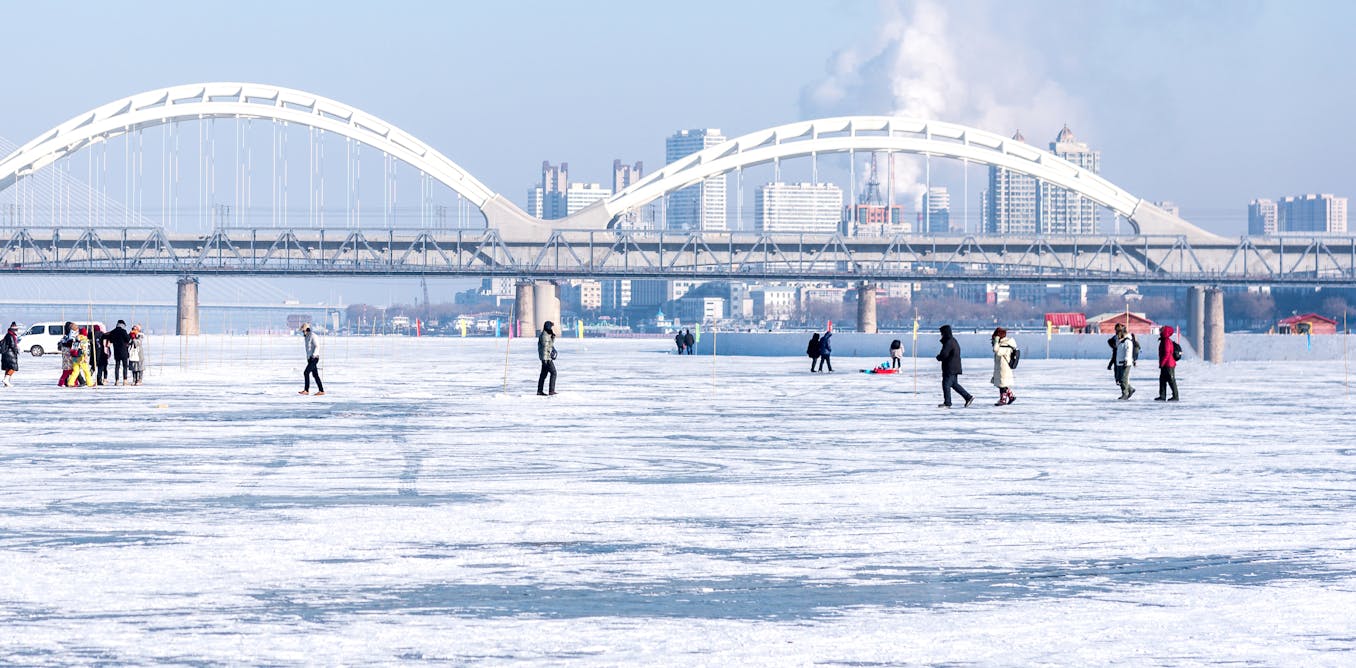
Harbin is NOT the world’s coldest city. Actually, I can pull up historical weather data and tell you that in January, Harbin is the 7th coldest average with an average of -3F.
The first two are in Russia, and the third is in Canada.
-22F is frigid, but we used to get that pretty frequently in the past. I think in 2019 Minneapolis had -27F. I saw -23F last week.
International Falls, MN has a record of -55F, Snag, Yukon has a record of -81F, and Oymyakon, Russia has a record of -91F (1924, more recently in 2018 it was -88F).