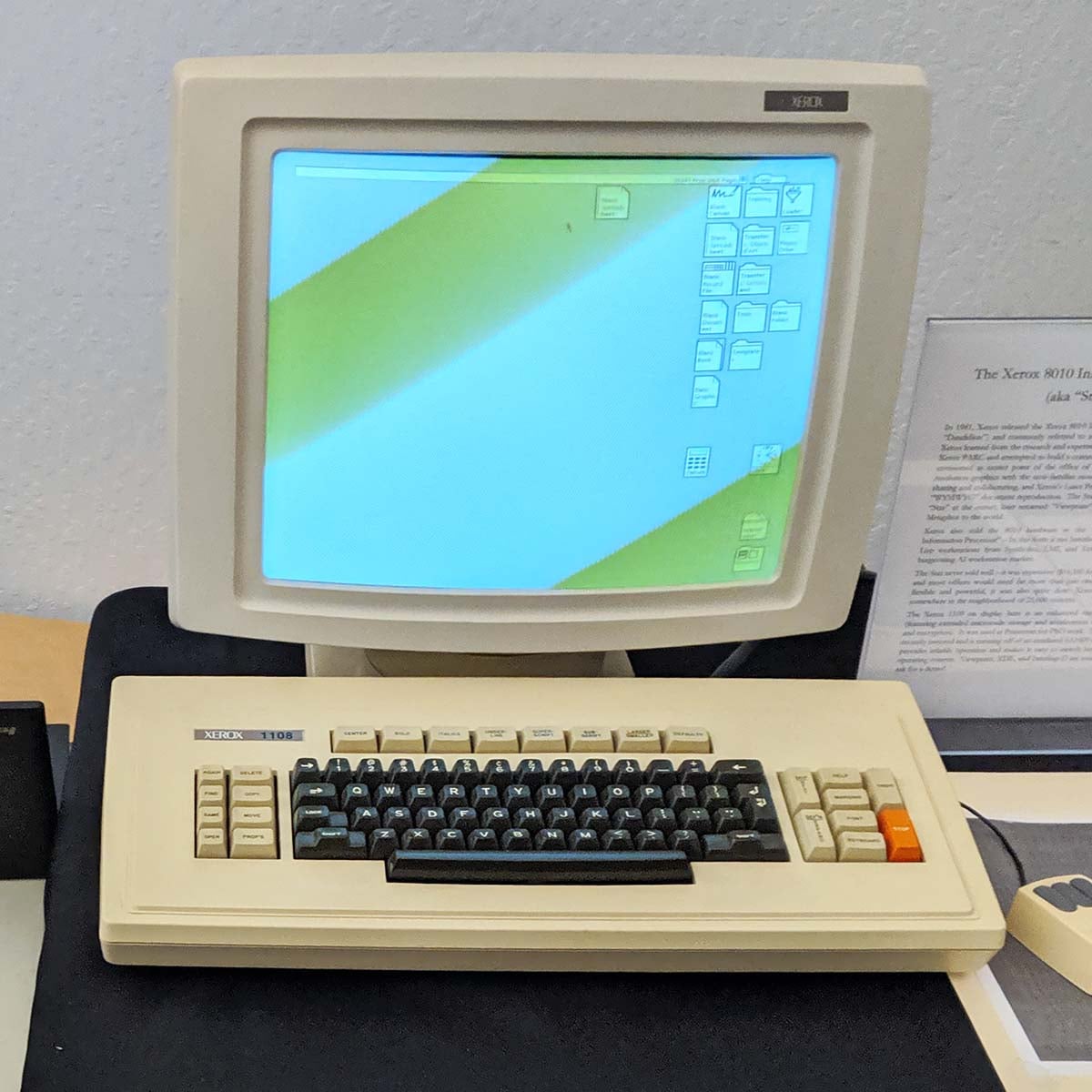
Well it didn’t really bring it to us because they never sold it to anyone. They could have been the top dog in computing
Do you mean that sales were poor? If not, and you mean that literally, then they did – about 25,000 units, making it a commercial failure, but nevertheless “brought”.
Oh I didn’t realize they actually sold it as a product. I thought it never left the lab, sorry.
It cost $32,000! That’s $120,000 in now money, it was like luxury car money or small house in the sticks money.
One of Apple’s early tricks was efficient board designs with low chip counts that let the charge less (I know, it’s hard to imagine now). The Macintosh was many of the same features, a friendlier design, and cost $2500, which was still really nice used car money in 1985.
Xerox made a bunch of bad business decisions that caused a household name to disappear.
Xerox invented the GUI, mouse, and Ethernet. But basically because sales didn’t immediately do well they killed revolutionary innovations and let IBM, Apple, and Microsoft benefit from their work.
Remember Kodak too but it’s not their fault someone else took digital photography and actually did something with it.
Didn’t the Xerox Alto have a GUI? That was released in 1973.
The first I used was gem on the Atari ST, was pretty cool and highly intuitive
Atari ST gang represent!
My 520ST paid much of my way through university using PaperClip to format documents for other students.
It led me into exploring TeX on the school mainframe, and unix.
Later, I worked with possibly the very first gui granular synthesizer program, developed on a ST1040, which was kind of old at that point.
Back in 1995, I did “0300” work for AT&T - customer service for residential long distance customers. We used Xerox machines of some sort. I don’t remember all that many details, but it was probably a successor to the Star systems. There was a GUI and windows, although almost everything we did used terminal-type windows, connecting to various systems to look up information and make necessary changes. I do remember there was a GUI-type app for the ANI - automatic number identification - that basically gave us caller ID (number, no names) when we got a call. It didn’t always give us the number, but usually did.
I was so young and hadn’t learned yet (with my then-undiagnosed ADHD) that phone jobs were NOT a good fit for me… I’d log in each day to customize the colours and sizes of things, which it wouldn’t save once I’d logged out. But I couldn’t stand the defaults, and also it slowed me down getting on the phones (although it counted against me and was part of the reason I lost that job - time spent outside of the queue. heh)
Wow, always thought this was just a demo, the apps actually look pretty well fleshed out
Every time this gets brought up it makes me want to mess with SmallTalk again.
PARC Life